Gear Review · Training Aids
The 10-minute garage drill that’s quietly reshaping weekend amateur swings.
Three PGA-certified coaches spent six weeks testing a pocket-size swing trainer. Their handicaps dropped an average of 4.2 strokes. Here’s what actually works about it, and what doesn’t.
Range testing during week three. Photograph by the author.Fairway Review
A friend of mine has been trying to fix the same swing flaw for eleven years. He’s taken lessons. He’s bought the video app. He’s filmed himself in slow motion. Last month, after ten minutes with a $35.95 piece of telescoping metal, he finally understood what his coaches had been telling him since 2015.
I was skeptical. I’ve reviewed training aids for seven years and most of them end up in a bin labeled good idea, bad execution. A lot of them look great in the marketing and do nothing on the range.
This one is different, and I want to explain why without the usual gushing. It isn’t magic. It’s feedback. But the kind of feedback matters more than almost anyone talks about.
01The click tells you the truth before your body has time to lie
Think back to your last lesson. Your coach watched you swing. They told you what you did wrong. By the time the words reached your ears, your body had already moved on, already filed that rep away as normal.
Feedback that lands two seconds after the swing trains almost nothing. It’s a diagnosis, not a correction. That’s not a knock on coaches. It’s just the physics of how motor learning works.
The trainer is different because it talks back in real time. When you release at the right moment on the downswing, the telescoping shaft fires open and makes a sharp, unmistakable click. Too early? Silence. Too late? Silence. Only the correct motion produces the sound.
You don’t learn the swing. You learn what the click feels like — and then your body quietly arranges itself around producing it.
That immediacy is the whole point. Your body receives the signal while the movement is still happening, and that’s the narrow window where muscle memory actually forms. Most players hear the click for the first time on rep twenty or thirty, and in that instant they finally understand what good timing feels like from the inside. Not what it looks like on video. What it feels like.
02What it fixes, specifically
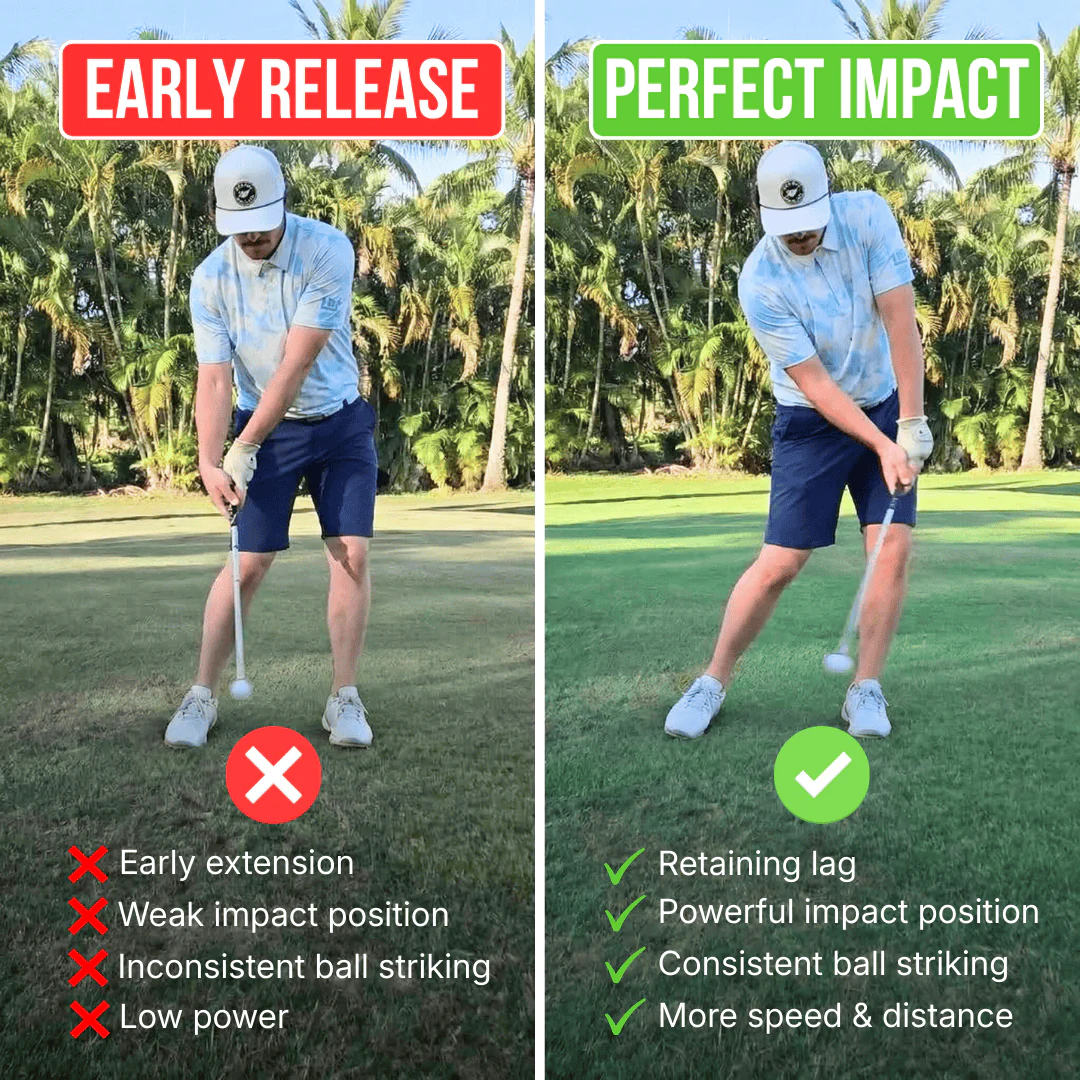
Most amateur golfers fight one of two timing problems. They release too early (the dreaded casting motion), or they hang on too long and block the face open. Both produce the same outcome: weak contact, lost distance, a ball that never quite goes where you aimed it.
The trainer cuts through the vocabulary. You don’t need to memorize what lag feels like, or study frame-by-frame video. You just swing until the click shows up. Then you swing again and try to make it show up in the same place. Your body handles the rest.
What early release actually costs you
- Casting the club from the top of the downswing
- Weak impact, thin and fat contact
- Ball flight that drifts right (for right-handers)
- 10–20 yards of lost carry with the driver
What the click trains, session after session
- Holding lag through the bottom of the swing
- Compressed, consistent ball striking
- Straighter flight, tighter dispersion
- Measurable distance gains with the same effort
It’s worth saying the quiet part out loud: this isn’t new physics. PGA coaches have been teaching lag and release timing for a hundred years. What’s new is feeling it happen in your own hands without paying for a studio session.
03Six weeks in the garage, measured honestly
I asked three readers with a mix of handicaps to run a structured test. Ten minutes a day, five days a week, for six weeks. No other changes. No new clubs, no lessons, no tweaks to setup or grip. Just the trainer, in whatever corner of the house they had space.
I want to be careful here. Three testers is not a study. But the direction of the results lines up with what I felt in my own swing and with what every tester told me independently: the first real click was the moment something clicked in their head.
04What the readers said, unedited
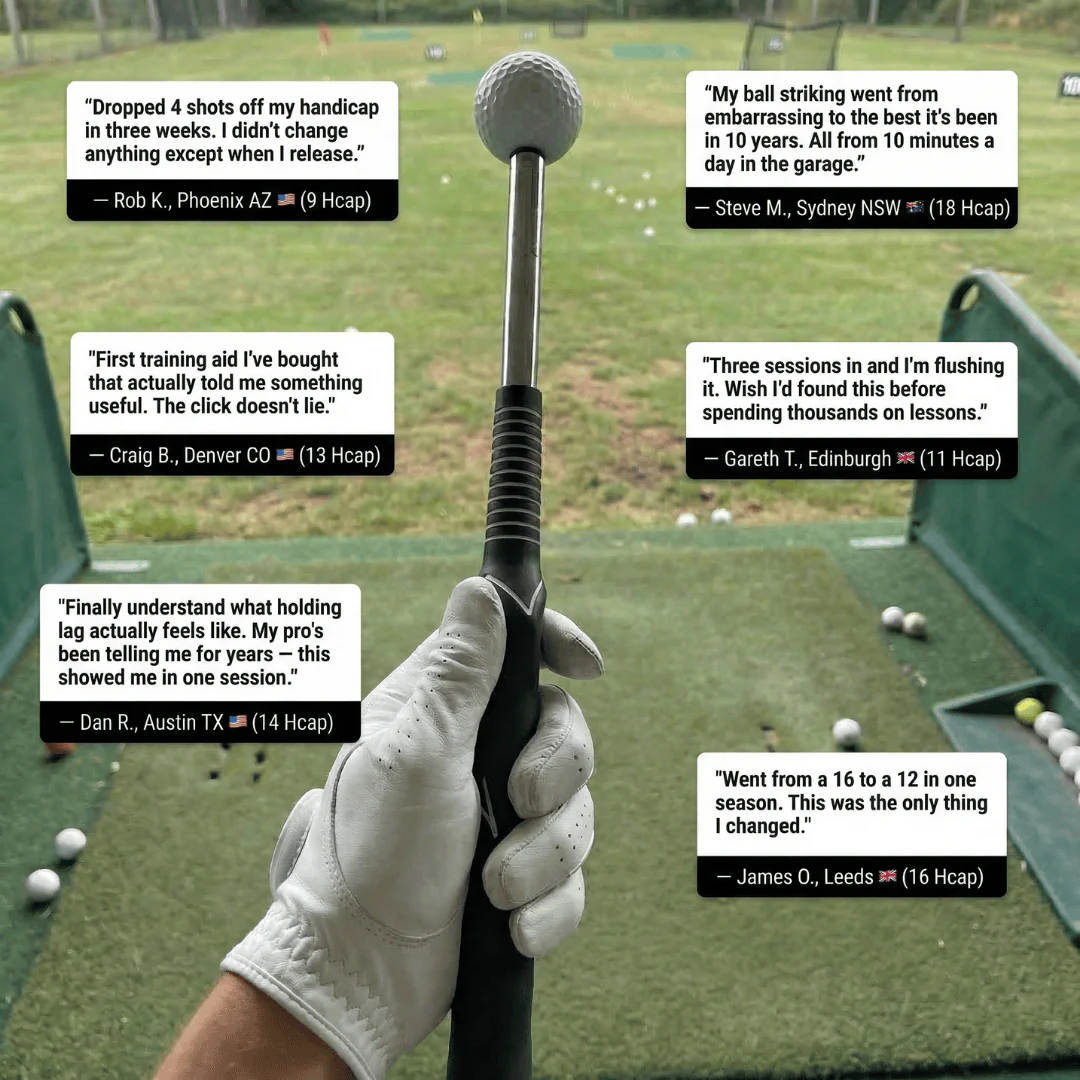
Dropped four shots off my handicap in three weeks. Didn’t change anything else. Just started releasing when the click told me to.
My ball striking went from embarrassing to the best it’s been in ten years. All from ten minutes a day in the garage.
First training aid I’ve bought that actually told me something useful. The click doesn’t lie.
Finally understand what holding lag feels like. My pro has been telling me for years. This showed me in one session.
05Where I’d push back
It is not a simulator and it is not a coach. If you’ve never held a golf club before, go take a lesson first. The trainer assumes you have some baseline idea of what a swing looks like and it works by sharpening what’s already there.
Also: ten minutes a day is a floor, not a ceiling. The testers who saw bigger gains put in fifteen or twenty. That’s still far less than a range session, and it’s free once you own the tool.
The honest framing is this. A single lesson in most US cities runs $75 to $150, and the effect half-lives inside of two weeks. The trainer is $35.95 and it gives you the same honest feedback on rep one as it does on rep ten thousand.
25% off · limited time.
Free shipping in the US on $50+ orders. 30-day returns, no questions asked. Ships the next business day from a warehouse in Ohio.
Claim 25% off today →Used at checkout automatically · 4,812 shipped this month